

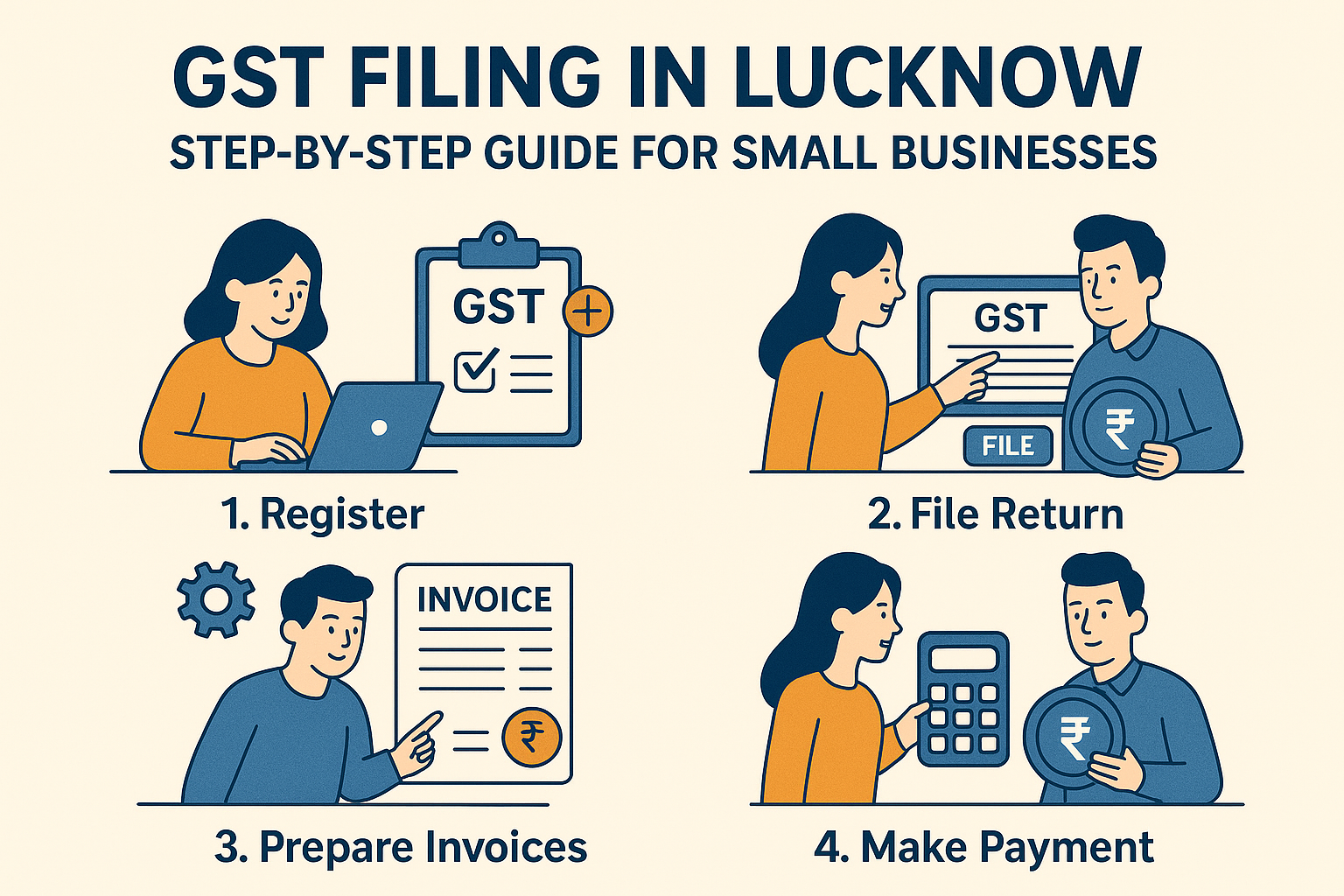
GST (Goods and Services Tax) is a unified indirect tax system introduced in India to simplify and centralize the tax structure. While it has streamlined many aspects of taxation, small business owners still find GST registration and filing to be confusing and time-consuming.
Whether you’re a startup, a retail shop, or a service provider in Lucknow, it’s essential to file your GST returns accurately and on time to avoid penalties and legal complications.
In this detailed guide, we at CRM And Company — a professional CA firm in Lucknow — break down the step-by-step process of GST filing, including the documents you need, types of returns, and common mistakes to avoid.
What is GST Filing?
GST filing is the process of submitting tax return forms to the government, declaring your business’s sales, purchases, output tax (GST on sales), and input tax credit (GST paid on purchases).
Who Needs to File GST?
You need to file GST returns if:
-
You are a registered GST taxpayer
-
Your annual turnover exceeds ₹40 lakh (₹20 lakh for services)
-
You are involved in interstate sales, e-commerce, or import/export
-
You have opted for the composition scheme
Even if your turnover is below the limit but you have voluntarily registered, you must still file returns.
Step-by-Step GST Filing Process in Lucknow
Step 1: GST Registration
If you haven’t already, the first step is to register your business under GST. You can do this online on the GST portal. You’ll receive a 15-digit GSTIN after successful registration.
Documents Required:
-
PAN Card
-
Aadhar Card
-
Business address proof
-
Bank details
-
Photograph of owner/proprietor
-
Company registration proof (if applicable)
Need help? CRM And Company offers GST registration assistance in Lucknow.
Step 2: Understand the Types of GST Returns
GST return types depend on the nature of your business and turnover:
| Return Type | Description | Frequency |
|---|---|---|
| GSTR-1 | Outward sales data (B2B & B2C) | Monthly/Quarterly |
| GSTR-3B | Summary of sales, ITC, tax paid | Monthly |
| GSTR-4 | Composition scheme return | Annually |
| GSTR-9 | Annual GST return | Annually |
| GSTR-9C | Reconciliation Statement | Annually (if turnover > ₹5 Cr) |
Most small businesses need to file GSTR-1 and GSTR-3B regularly.
Step 3: Prepare Your GST Data
Maintain records of:
-
Sales invoices (with GST breakup)
-
Purchase invoices
-
Debit/Credit Notes
-
Input Tax Credit (ITC) available
-
GST paid
Use accounting software or hire a CA firm like CRM And Company to maintain digital records and prepare GST data monthly.
Step 4: File GSTR-1 (Sales Return)
Due Date:
-
Monthly: 11th of the following month
-
Quarterly: 13th of the month after the quarter (for QRMP scheme)
Details Required:
-
Invoice-wise B2B sales
-
Consolidated B2C sales
-
Exports
-
Nil rated or exempted sales
You can file it via:
-
GST Portal
-
Offline Utility Tool
-
Authorized GST Suvidha Providers (GSP)
Late filing attracts a penalty of ₹50/day (₹20/day if nil return).
Step 5: File GSTR-3B (Summary Return)
Due Date: 20th of the following month
Details Required:
-
Total outward taxable supply
-
Input Tax Credit (ITC) claimed
-
Tax payable and paid
Payment of Tax:
If you have GST payable, make the payment using Challan Form GST PMT-06 before filing GSTR-3B.
Filing GSTR-3B is mandatory even if you had no sales or purchases in the month.
Step 6: Use Input Tax Credit (ITC) Wisely
You can reduce your tax liability by claiming Input Tax Credit on your business-related purchases and expenses.
Ensure:
-
Invoices are in your business name
-
Supplier has filed GSTR-1
-
You have received the goods/services
Mistakes in claiming ITC may lead to notice and penalties, so double-check ITC entries or consult a CA.
Step 7: File Annual GST Return (GSTR-9)
All businesses with turnover above ₹2 crore must file GSTR-9.
Due Date: 31st December of the next financial year
GSTR-9C (Audit): Mandatory if turnover exceeds ₹5 crore
CRM And Company can help you file error-free GSTR-9 and GSTR-9C before the deadline.
Common GST Filing Mistakes to Avoid
-
Filing incorrect GSTIN
-
Mismatch between GSTR-1 and GSTR-3B
-
Not reconciling ITC claimed with GSTR-2B
-
Missing due dates
-
Not filing nil returns
-
Claiming ineligible ITC
Hiring a professional CA firm ensures you avoid these costly errors and stay compliant.
Why Hire a CA Firm in Lucknow for GST Filing?
Hiring a local CA firm like CRM And Company gives you:
-
Expert handling of GST registration & return filing
-
Monthly record keeping and reconciliation
-
Timely reminders and deadline management
-
Legal assistance in case of notices
-
Peace of mind so you can focus on growing your business
We serve all types of businesses in Lucknow — from traders and retailers to e-commerce sellers and consultants.
Our GST Services at CRM And Company
-
GST Registration
-
GSTR-1 & 3B Filing
-
GSTR-9 & GSTR-9C Filing
-
Monthly Reconciliation
-
GST Audit Support
-
ITC Verification
-
GST Notice Reply
Get in Touch
Want a reliable partner to manage your GST?
👉 Call us: +91-8858008114
👉 Email: crmandcompany20@gmail.com / info@crmandcompany.com
👉 Visit: www.crmandcompany.com
Final Words
For small businesses in Lucknow, timely and accurate GST filing is not optional — it’s essential for legal compliance and business reputation. Don’t let paperwork and penalties slow you down.
With the help of a trusted CA firm like CRM And Company, you can simplify GST processes and stay 100% compliant — all while focusing on what you do best: growing your business.